REALITY DESIGNDec 12, 2025
Are We Simulating Our Own Reality?
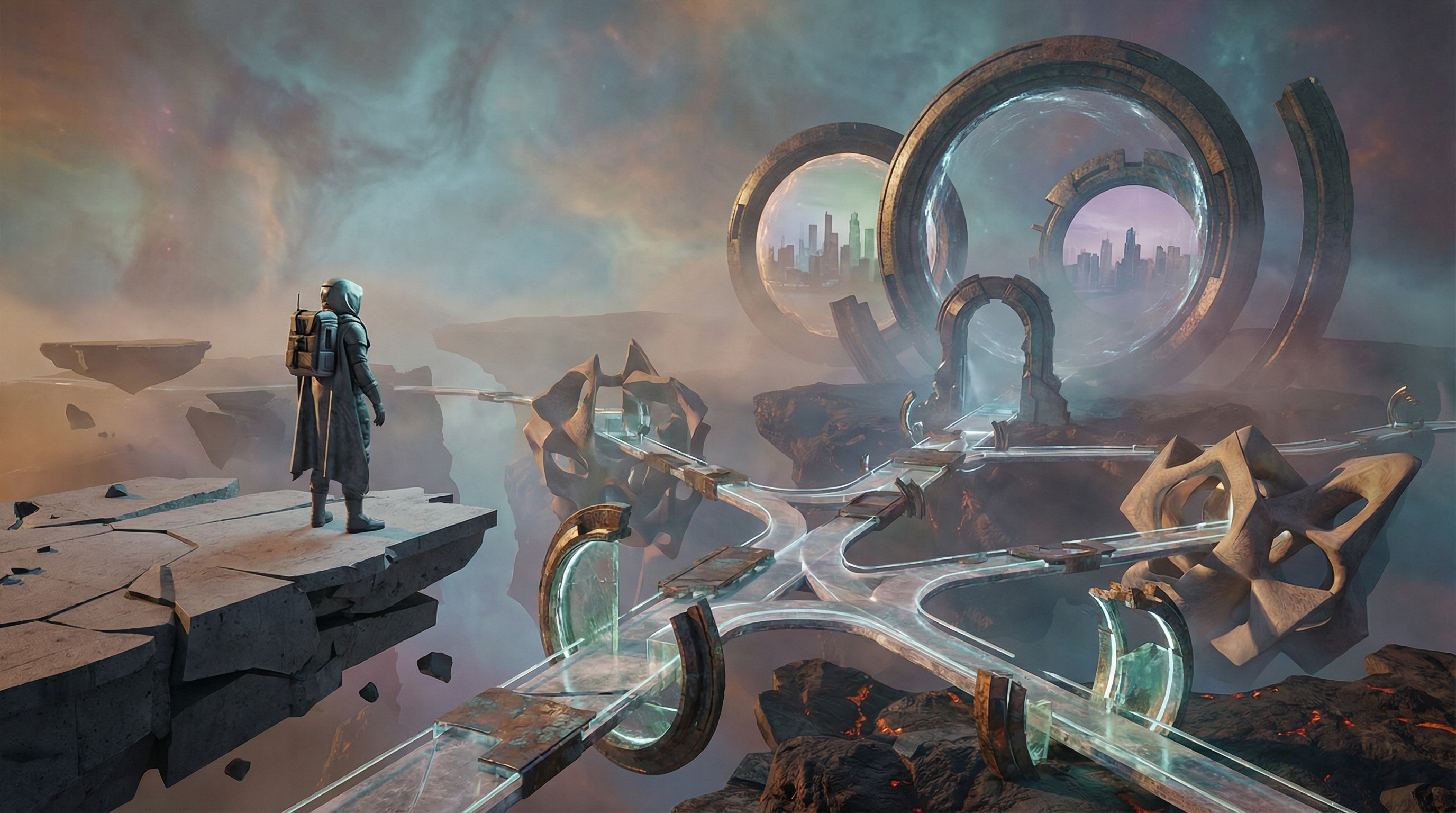
Ever had that feeling like life's just a series of planned events? Or, like, maybe we're all just part of some massive multiplayer simulation? Dive into this concept that's got thinkers questioning the very nature of reality.

Raymond
Reality Designer
2min
Ever notice how sometimes life feels too orchestrated to be random? Like when you're thinking about someone and they suddenly text you, or you bump into an old friend in a city neither of you lives in? It's those moments that make you wonder if we might be living inside some elaborate computerized reality. I mean, it's kinda unsettling, right? This feeling isn't isolated to just you or me. There's a whole bunch of people, including legit smart folks, who are diving deep into these questions, probing at the edges of what we understand as reality.
The idea of life being a simulation isn't just sci-fi fodder from directors like Christopher Nolan. It's a legitimate philosophical query. Nick Bostrom's Simulation Theory, for example, suggests that we're probably living in a computer simulation created by a more advanced civilization. The gist is, if you believe that future generations will have the computing power to run detailed simulations of their ancestors, it's plausible that we're in one of those simulations right now. The crazy part? Statistically, it's more likely we're in a sim than not.
But what does that mean for us, the players in this game, if it even is one? For one, it could shift how we approach everything, our ambitions, our ethics, and even our relationships. Imagine knowing your life decisions might just be lines of code in a sprawling virtual environment. How would that change things? Would you take more risks, knowing your actions might not be as consequential as you once thought? Or would you play it safe, fearing the unknown variables that govern the simulation?

On a more mind-bending level, think about how our consciousness might perceive and interact with this simulated world. If reality is coded, could we hack it? People talk about "hacking" their lives, optimizing productivity, health, and mindset. But what if there's a literal framework to hack? If consciousness is the keyboard and intention is the code, could we rewrite some of the basic rules?
Here's the thing, though: even if we're not living in a mega-simulation, the tech around us is pretty much crafting mini-simulations every day. Social media, for example, is like a feedback loop constructed to meet our desires and fears, constantly adapting based on our online behaviors and interactions. It's more than just algorithms throwing ads at you; it's a complex design aimed at simulating a world where your values and interests hold central importance. Have you scrolled Instagram and just felt overwhelmed by how everyone seems to be living their best, most curated lives?
The real question.
I had this conversation with my friend Mike last weekend over coffee. He's knee-deep in tech, fascinated by how algorithms echo our human tendencies. He joked about our reality being a simulation as we discussed a news headline that seemed too on-the-nose. Mike pondered, what if our algorithms are the new architects of reality? They're creating narratives for us, bit by bit, coordinating our experiences almost seamlessly. It’s like we’re co-creating a reality with the tech we’ve built, except maybe we're not in the driving seat as much as we think.
Take the Metaverse, for example. Mark Zuckerberg is betting big on this virtual realm blending our perception of what's digital and what's tangible. It's like the digital garden of Eden, minus the apples and snakes. And even though I've not exactly pledged allegiance to the Metaverse guild, the potential is wild. Work, social interactions, entertainment, everything could blend into this virtual sandbox where our artificial avatars carry the weight of our real-world identities.

But what about the philosophical angles? If consciousness is a product of neural connections and these can be replicated in a digital realm, are AI entities conscious? Are we creators of new life forms or just designing intricate mimics of life? It begs the question of responsibility and ethics. We're in this uncharted territory where reality construction feels almost like storytellingPOST, except now the characters might just start developing narratives of their own.
And then there’s the existential dread of it all. If we're mere pixels in some cosmic game, does anything we do matter? It's not as depressing as it sounds. Actually, it could liberate us. If this is a simulation, we're free to push boundaries, test limits, and redefine rules without a cosmic slap on the wrist. It's the ultimate sandbox. What we create, how we interact, and the values we uphold become the markers of our existence in this grand digital symphony. You'll find this sort of liberation discussed in Creator GrowthPOST circles, where innovation is about boundary-breaking, not playing it safe.
But let's not get carried away. Even if we're not sims, pondering the "what if" scenarios forces us to challenge our assumptions about reality. Maybe it's about recognizing that the lines between virtual and real are blurring faster than ever, and our task is to navigate these waters thoughtfully. It's like waking up each day to a new level of a game, but we bring yesterday's skills and knowledge forward, continually adapting and evolving.
What do you think would happen if we all started treating life as a semi-simulated space where meaning is co-constructed? Would societal progress happen faster because people would feel less tied to dogmas and more open to experimentation? Would it lead to a grander understanding of consciousness, or perhaps even a new sense of spirituality rooted in innovation? These questions might not provide answers, but they definitely open a wide path worth walking down, one that's filled with new possibilities and fresh paradigms.

It's easy to shrug off these ideas as mere conspiracy fuel, yet they're pushing us to ask deeper questions about what it means to be human in an increasingly digitized world. We're at a crossroads where tech isn't just a tool; it's becoming the very environment in which we live. The internet-native generation like you and me, we’re the architects and the guinea pigs.
But let's dive into even messier waters. What if interpreting the universe as code changes how we interact with it? Like, what if by recognizing the universe as this grand operating system, we unlock new ways of seeing and interacting with it? It's a bit Matrix-y, sure, but what if the. power of perception lies in comprehending the underlying code of our experiences, allowing us to manipulate reality in a sense?
There's this notion of manifestation, popular in self-help circles. It's the idea that you can bring your desires into reality through focus and intention. In some ways, it's like hacking your personal simulation. But the counterargument is just as compelling: Are we truly shaping the universe, or simply reprogramming ourselves to recognize opportunities more clearly?
And that’s the kicker. In chasing the simulation rabbit hole, we might just discover more about our minds than the universe itself. Perhaps it’s not about discovering whether we're simulated, but understanding the nature of consciousness, the way we process, interpret, and co-create our worlds every day. Maybe reality isn’t as fixed as we like to think.
So, the threads we pull might unravel nothing or everything. And this thought keeps me spiraling into a hundred tangents, each unveiling new landscapes of possibilities and questions. And here’s the real mind-bender: Maybe this exploration, the constant questioning without end, is the point. Because reality, whether simulated or not, was never about having all the answersPOST, it's about the questions that lead us to growth and understanding.